Showing posts with label fiction. Show all posts

Wednesday, September 11, 2013

Guest Post: Kate Voss's Top 5 Detectives

This special guest post is from Kate Voss. She's talking about her Top 5 detectives, leading up to the upcoming movie based on the classic Encyclopedia Brown series. Take it away Kate!

Top Five Detectives in Literary History

Nothing compares to jumping into an alternate reality, being presented with a string of clues, and then being left to wonder how to solve a mystery. The pure wonderment and complex solutions that mystery novels allow readers to experience is the reason they are my favorite genre.

In celebration of the 50th anniversary of the popular Encyclopedia Brown detective series, I have created a list of the best fictional sleuths in literature, from the bumbling and obese Nero Wolfe, to the feminine and feisty Nancy Drew.

5. Nero Wolfe, by Rex Stout

An armchair detective, a more extreme version of the infamous Sherlock Holmes, Wolfe solves crimes from the comfort of his home by reading the newspaper and listening to verbal accounts but never actually visiting the crime scene. Introduced in 1934 by Stout, the series features Wolfe’s sidekick Archie Goodwin, who is the street-smart narrator and manages the investigations outside of the brownstone that Wolfe refuses to leave. Wolfe is an eccentric, and quite large (estimated to be around 350 pounds), homebody who has the evidence for each case brought to his doorstep. Nero Wolfe was made into a television series called A Nero Wolfe Mystery by A&E in 2001, and starred Maury Chaykin as Nero and Timothy Hutton as Archie.

Favorite Story: “The League of Frightened Men,” 1935
Trademark: arrogant, hefty recluse with a strict schedule


C. Auguste Dupin, by Edgar Allen Poe

The clever Dupin was first introduced in 1841 in Poe’s story The Murders in the Rue Morgue, which is widely considered to the first-ever detective story. Apparently, Poe wrote these stories before the word “detective” was ever coined, and the Dupin character helped create the foundation for future detective novels to come. Dupin solved crimes by using his imagination and putting himself in the shoes of the criminal -- “If I were a criminal, what would I do?” Poe dubbed this type of thinking as “ratiocination.”

Dupin also has a narrator wingman, but is his name is never revealed within the three stories. Dupin is an eccentric, nocturnal observer who uses his senses to help the police solve crimes. The Murders in the Rue Morgue inspired one of the crimes in the 2012 film "The Raven," starring John Cusack.

Favorite story: “The Murders in the Rue Morgue,” 1841
Trademark: “Ratiocination”-- thinking like the criminal
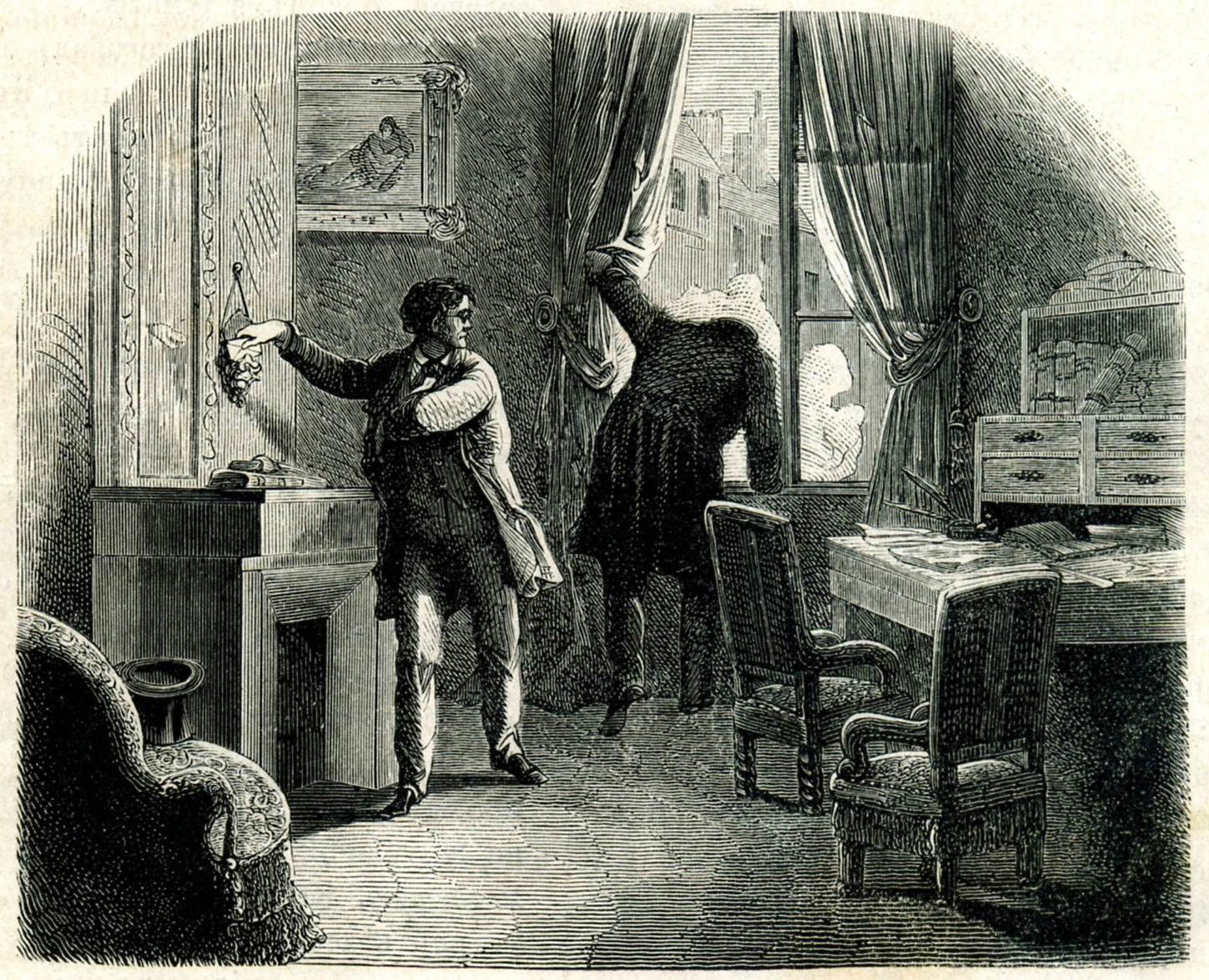

3. Nancy Drew, by Carolyn Keene

The books Keene wrote about amateur detective Nancy Drew were some of the first popular detective stories to employ the skills of a female sleuth. I remember reading The Hidden Staircase when I was 9 years old and being wowed by Nancy’s wit and young age. Using the pseudonym of Carolyn Keene, many authors contributed to this series (to the horror of us Carolyn Keene diehards). In the original version, Nancy is an independent 16-year-old high school graduate who stumbles upon crimes (sometimes originating from her lawyer father’s cases).

The young Nancy Drew, who was introduced in 1930, has become a cultural icon-- the books have sold over 80 million copies, have been translated into over 45 languages, and have been adapted into five big screen flicks (one starring Emma Roberts), and two television series.

Favorite story: “The Hidden Staircase,” 1930
Trademark: feisty young prodigy


2. Sherlock Holmes, by Sir Arthur Conan Doyle

The Sherlock Holmes character has been reworked and crafted again and again as the years go by to resemble a more contemporary version of this popular sleuth. Many consider Sherlock Holmes to be the king of detection, the face of observation. Originally created in 1887, Sherlock Holmes is a consulting detective who has astounding observation skills. He can use abductive reasoning to solve any crime. Holmes, and his crime-solving friend and partner Dr. Watson, appear in four novels and 56 short stories. The Sherlock character has been made into many TV series and big screen flicks, including BBC One’s Sherlock, Elementary, and the 2009 film "Sherlock Holmes" starring Robert Downey Jr.

Favorite stories: “A Study in Scarlet,” 1887
Trademark: extraordinary knowledge, logical reasoning and attention to detail


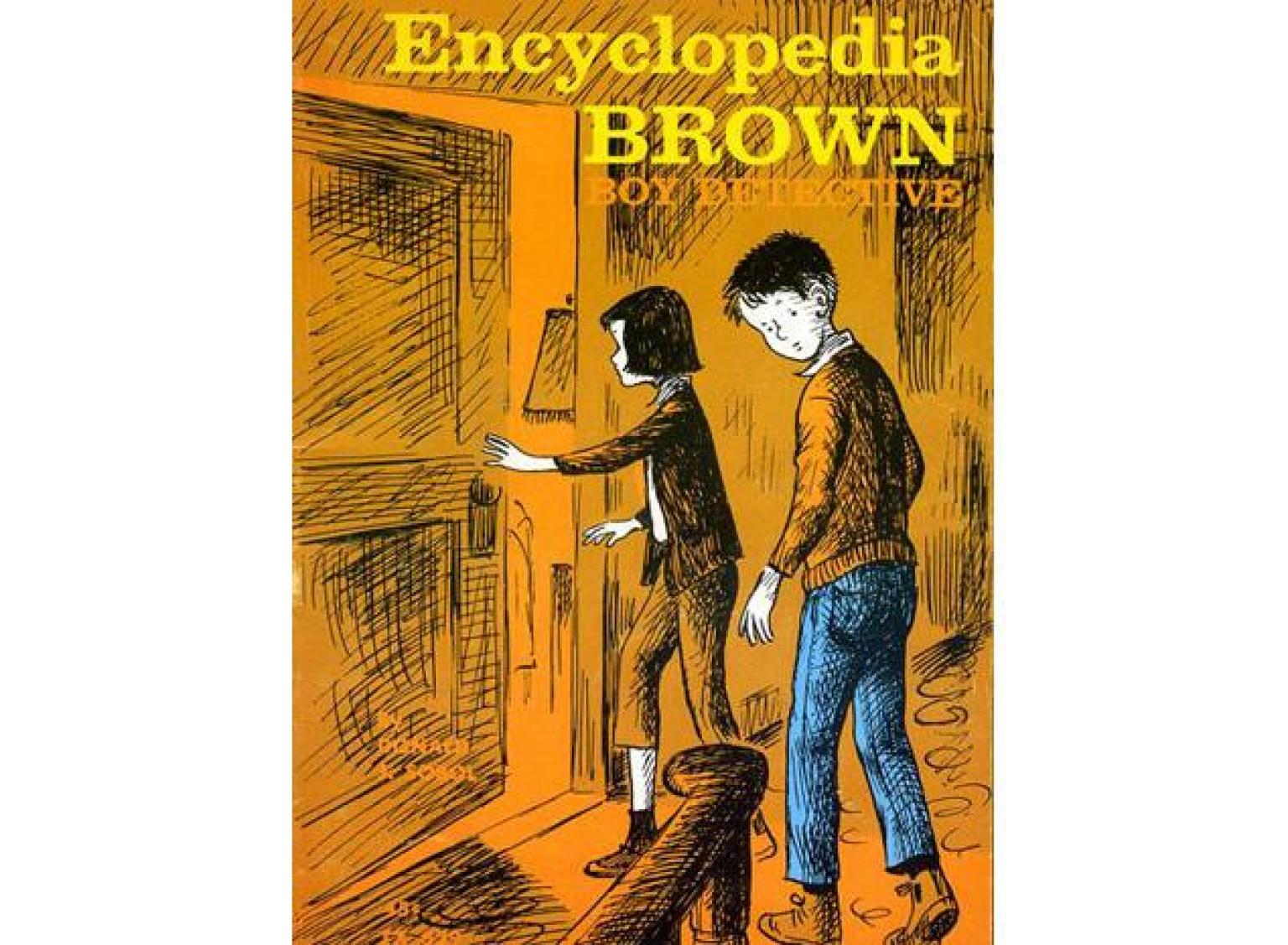
1. Encyclopedia Brown, by Donald J. Sobol

Encyclopedia Brown is a children series created 50 years ago, featuring the brilliant boy detective, Leroy “Encyclopedia” Brown, who knows just about everything. This series is unique in that it lets the readers decide the fate of each story, and then provides the answer to the mystery in the back of the book. It is sort of a “create your own adventure” style of reading.

Each story in the series begins with the same formula - Brown solving a case at the dinner table for his father, the local police chief in the fictional town of Idaville, by briefly closing his eyes, thinking deeply, and then asking one single question which directly leads to him finding the solution. His enemy in most stories is the town bully, Bugs Meany, and his sidekick is Sally Kimball. The series was adapted for television in 1989 in the HBO series Encyclopedia Brown, and is soon to be made into a feature film by Warner Bros.

Favorite story: The Case of the Kidnapped Pigs from “Encyclopedia Brown Saves the Day,” 1970
Trademark: closing his eyes and thinking deeply

Author Bio: Kate Voss is an entertainment writer for GetDirectTV.org. Kate lives and works in the windy city. She is an avid reader of detective novels and her favorite TV show is BBC’s witty series, Sherlock.

Monday, January 28, 2013

Turning a Writing Corner

by Mary Sutton / @mary_sutton73

I've always been kind of happy that I can watch TV shows without descending into writing nitpicks. I mean, sometimes you just want to watch a show without obsessing about the details, right?

Well, lately, the husband and I have enjoyed watching old episodes of A Touch of Frost, an old police-detective series from the BBC. We like the BBC and we like mysteries - so this is a good match. We've really been enjoying the show, despite the face that they killed off one of our favorite recurring characters at the end of Season 4 (kill your darlings anyone?) and came perilously close to my #2 pet peeve, killing a dog (they didn't, the dog lived, rest easy).

As a writer of crime fiction, I've been able to turn off that part of my brain. But last night, I think I turned a corner.

The episode starts with Frost facing a pile of bills, having his utilities disconnected for non-payment, and bemoaning "expenses," so he takes in a renter to help cover the costs. But, but, but...

Frost's wife died in Season 1 after a long illness where he had to pay for home health care. We're now in Season 5. He hasn't changed jobs. There's been no mention of pay cuts at work. So why is he only now having financial trouble? Just boom! out of the blue he can't pay the bills? No mention of this before? Really?

Then, a government health official throws an expensive leather jacket over a barbed wire fence to break into a meat packing facility after hours? What mid-level government official does that - no matter what nefarious business he thinks the company is up to?

When I mentioned all this, my husband looked at me and said, "That's really bugging the crime fiction author in you, isn't it?"

And it hit me - I can't dissociate the two parts of my brain. The writer part and the watcher/reader part.

I can't read a book without hitting a clunky part of dialog and wincing, or wanting to applaud a particularly well-written exchange. Character actions, conflict, climax, plotting - all of it gets the authorial treatment. If it worked for me, why? If it didn't, why not?

I can't decide if this is a good thing or a bad thing. On the one hand, it's good because I think it shows I have a new awareness of these things - which can only help my own fiction. On the other hand, I run the risk of over-analyzing everything I read, and potentially destroying the primary reason I read fiction - to escape and not have to think.

But now that I've noticed this, I can't turn it off - for better or for worse. At some level, I know I'll be constantly analyzing the writing, picking apart the things that delight and the things that, well, don't. And I guess that's just part of being in the fiction realm. But one thing's for darn sure.

I'll never look at a critique group the same way again.

What about you? If you're a writer, do you analyze what you read - especially works in your preferred genre?

Image from Flickr used under Creative Commons

Friday, October 12, 2012

Hero's Sword: Power Play - Excerpt 2

by Mary Sutton / @mary_sutton73

I leave for a fun-filled writing weekend in a few hours, but I leave you with a second excerpt from the upcoming ebook, Power Play: Hero's Sword Volume 2. In this scene, Jaycee facts a test with the sword - a test that could make the difference in proving that she is indeed Lyla Stormbringer.

If you missed the first excerpt, read it here.

*************

We walked back to the manor grounds, the crowd following. I could hear bits of conversation, people debating whether or not I was Lyla Stormbringer. I took this as progress. When I’d arrived no one had believed me. At least people were wondering now.

The practice ring was a circle approximately fifty feet in diameter with a raised border. Roger stepped into the ring and motioned for me to follow. “Lyla Stormbringer is a fearsome blade,” he said, making sure the entire crowd could hear. “It is only fitting, therefore, that she have a strong opponent, someone who can challenge her - me.” Roger unsheathed the sword on his hip and bowed.

I fought to keep my face expressionless. I had to fight Roger? On the one hand, this was good because I was sure he wouldn’t kill me. On the other hand, I was also sure he was a pretty good swordsman himself, so he wouldn’t give me a break either. I flexed my hands, drawing in deep breaths and trying to calm the butterflies in my stomach.

I drew my own blade. The leather-wrapped hilt felt good in my hand, like it belonged there. The sword was neither too light nor too heavy, and the sunlight shone off the blade. I rolled my wrist a couple times, drawing circles in the air. It felt natural. I smiled, swung my sword up in a salute, the way I saw in the movies, and bowed. Roger also smiled and we stepped into a ready position.

This might be fun. Then Roger attacked and I changed my mind. This might be deadly. Roger hadn’t been kidding, he was good and it took all that I had to block his flurry of attacks. There were a couple of times that I thought he’d get me, but he didn’t. I was sure I was working on reflex alone, because it wasn’t skill.

I had never swung a real sword. The closest I’d gotten was when I played Zelda on Stu’s Wii. Believe me, swinging a video game controller is not training for swinging a real sword. Roger chased me all over the ring, blows coming at my head, side and feet. I was managing, but barely. It was just a matter of time before he scored.

Once again, the muttering started. Whatever street cred I’d earned at the archery range was almost gone. Out of the corner of my eye, I saw the guy from the range elbow his neighbor and smirk. For some reason, that made my blood boil. A balloon rose in my chest and a ringing started in my ears. Enough was enough. Roger might beat me, but I wasn’t going to lose looking like a fool.

I went on the attack. The more I swung at him, the more Roger smiled. But I didn’t think it was the same kind of smile as the people watching. He looked pleased. I pressed him harder and sweat started to form on his brow, and the smile disappeared as he frowned in concentration.

I lost track of time, so I couldn’t tell you how long Roger and I stomped across that ring. He swung at my head and I ducked. I swung at his feet and he jumped. I blocked a wicked strike that would have carved a chunk out of my chest. I recovered quickly, faked a blow to Roger’s right and swung at his left side. He also reacted quickly and blocked my swing.

Sweat poured down my face, stinging my eyes and I could feel my shirt sticking to my back. I should have been terrified, but I’d never had so much fun. A fierce confidence that I’d never felt before burned in my chest. I still might lose, but I knew I was putting on a show.

After who knows how long, I saw my opening. I took a quick swing toward Roger’s head, but instead of swinging again when he blocked, I slid my blade down his and flicked my wrist in a circle. The move trapped Roger’s sword and twisted it out of his hands. It flew to the side and I held my sword inches from Roger’s throat. I was soaked with sweat and breathing like a sprinter after a race, but I smiled like I'd just been told I would be free of homework for the year.

Roger was also soaked, but his smile stretched across his face and his eyes twinkled. He nodded and I dropped my sword. He retrieved his own blade and we bowed to each other. I was breathing too hard to speak, but Roger held up my sword hand. “I declare this test passed,” he said, his voice ringing with something I could have sworn was pride. I bowed to the crowd.

“And now for the final test,” Roger said. “A test of wits.”

I was flying high. After the bow and the sword, I figured this would be cake. Boy, was I wrong.

Friday, September 28, 2012

Hero's Sword: Power Play Excerpt

by Mary Sutton / @mary_sutton73

So if you've followed me on Twitter and Facebook, you know that production has begun on what will, most likely, be my first published work. Power Play:Hero's Sword Volum 1 is the first book in a series for middle-grade kids, age 8-10. A good comparison would be the wildly successful "Magic Treehouse" books. The books are approximately 20,000 words and divided into chapters.

The Hero's Sword series arc follows eighth-grader Jaycee Hiller. All Jayce wants to do is keep her head down, avoid the cheerleading squad, and survive school. But when she finds herself inside her favorite video game, "Hero's Sword," she must become her avatar, Lyla Stormbringer. "Survival" takes on a whole new meaning as she works to rescue the estate of Mallory from marauding highwaymen.

To celebrate, I offer an excerpt from POWER PLAY for your enjoyment. This is an early scene in the book, after Jaycee is transported into her game and she meets her mentor.

Read a second excerpt here.

***************

I expected to come in contact with my floor, but instead something that felt very much like grass smashed against my cheek, and the smell of dirt and fresh air filled my nose. Really fresh air. I hadn’t smelled air this fresh since that camping trip my parents had forced me to go on in fifth grade.

As soon as my vision cleared, I stood up. My nose and skin hadn’t lied to me. Instead of standing in my bedroom, I was in the middle of a grassy clearing, surrounded by massive trees. The sky above me was a brilliant blue, clearer than I’d ever seen. There were no clouds. I brushed my hands off on my pants and froze.

I was not wearing my usual jeans and t-shirt. Instead, I wore a long-sleeve linen shirt and a close-fitting leather vest. My legs were in tight pants, not uncomfortably tight, but much tighter than I preferred. Instead of sneakers, I wore soft leather boots that came to my knee. There were leather cuffs around my wrists, embossed with some sort of logo, but it was upside down and I didn’t recognize it. The only thing that seemed to be the same was my hair, which was still in a ponytail. But when I pulled it forward, it was a different color, a much deeper brown than it was normally. A few strands stuck to my forehead.

I was about to look at the logos more closely, when a voice shouted behind me. “Stand fast! Who are you, trespassing here? Turn around and name yourself!”

I did what any normal thirteen year old would do. I held out my hands, and turned around. Okay, maybe most thirteen-year olds would have run. But as soon as I saw the owner of the voice, I was glad I hadn’t.

He was tall and muscular - and holding a sword like he knew how to use it. He also looked very familiar, from his dark hair to his boots. His skin was tanned, like he spent a lot of time outdoors. “Um, hi,” I said.

The stranger lowered his sword, but didn’t put it away. “Greetings,” he said. “Might I ask of your name?”

I looked around. “Before I tell you that, would you do me a favor?” The stranger furrowed his brow, but nodded. “Where exactly am I? Like, the name of the town?”

The man’s brow crinkled further. “You are in the estate of Mallory, lands of Lady Starla Caval,” he said. My stomach felt hollow. Mallory is the name of my estate in Hero's Sword. This was getting really weird.

“Uh, and who are you, exactly? I thought the lord of Mallory was Harald Caval.” I was afraid of the answer.

It wasn’t possible for his forehead to crease any further. “I am Roger Woodbridge, chief steward of Mallory,” he said. “Lord Harald is dead, Lady Starla is his daughter. “ The hollow feeling in my stomach increased. This was definitely weird.

I needed more information, right now. “So, Roger, what brings you to this clearing?” I said, trying to sound casual. Stu always tells me I’m horrible at that, but I tried anyway.

“I am on the lookout for a great hero of this land, the woman known as Lyla Stormbringer,” Roger said. “There is unrest in Mallory. Lady Starla’s reign is new and some of her people think she is unfit for her role. Bandits plague the highway and her ladyship cannot stop them. It is Lady Starla’s hope that Lyla Stormbringer can help bring peace to the estate and strengthen her rule.”

Okay, way, way too weird. This could not possibly be happening. The quest I had accepted was to hunt bandits on the main highway though Mallory. Had the Controllix brought me into the game? But that was impossible. I wouldn’t have believed it except for the fact that my pretend Mallory looked a lot like this place, there were characters named Roger Woodbridge and Lady Starla, and my avatar was definitely Lyla Stormbringer - and she dressed a lot like how I was dressed now. But somehow now seemed like a bad time to tell all this to Roger. Had I fallen asleep? I pinched myself, hard. It hurt. I looked around. Still in the clearing. Roger now looking at me in obvious concern. “Are you all right?” he said. “You seem dazed.”

I gazed at the trees again and the sky. I might as well go with it. I spread my hands. “I’m fine,” I said, even though I wasn’t feeling all that fine. “You said you were looking for Lyla Stormbringer. You found her. I’m Lyla.”

Wednesday, May 2, 2012

Baby Steps

So, the big news of today, I'm guest blogging for Writer Wednesday over at "The Blotter," a blog from my friend and Sisters in Crime sib Joyce Tremel. Check it out if you are so inclined, and read an excerpt from my first Jim Duncan short story.

Other than that, I've jumped into Rewrite #2 for the as-yet untitled novel. (I really must remedy that lack of a title thing.) I'm feeling pretty good about it. In Rewrite #1, I switched to third-person POV because I thought it was necessary. Then I took a great workshop in March and learned that wasn't necessarily true - so Rewrite #2 moves me back to first-person POV with limited third-person scenes.

Of more importance is introducing another character and added depth for the protagonist. Why should you care about her? Why does she care about this murder? Those kinds of questions. I've heard this referred to as "the hole in the heart" - essentially, the reason you are rooting for her.

When I first let someone read my draft, the main comment was, "Your character is too damn happy." Hopefully this second rewrite addresses that. I mean, I don't want her to be absolutely miserable, but I don't want Pollyanna either.

The body is dropped in chapter 1, but previously the idea of murder didn't happen until chapter 7. A bit late, so that concept has moved up to chapter 3.

Anyway, I feel like I'm on the right track. Progress by word count is tricky (since the words are really already written and I'm just adjusting), but I've worked through the first six existing chapters.

I added the equivalent of 12 chapters in the last rewrite. Wonder what I'll add/subtract this time?

Friday, April 27, 2012

Title First - or Story?

A few weeks ago, I cam up with a great title for a mystery: Every Other Wednesday is Murder.

Here's the problem. I don't have a story to go with it.

It's kind of a "chicken and egg" scenario. Usually I come up with the story first and struggle with the title. This time, the literary shoe is on the other foot. (Is that enough mixed metaphors for you?)

I'm working through an idea. But it happens in Pittsburgh. And my main character is a state trooper based out of the Washington, PA barracks. He has no reason to be in Pittsburgh.

Do you see my problem here?

Ugh. I suppose this is like buying a house. Don't fall in love with it. You have to be prepared to walk away. But I don't want to!

So I'm going to have to get creative. In the meantime, if anybody knows of a legitimate reason for a state trooper to be in Pittsburgh, let me know.

Thursday, April 26, 2012

Life is Fiction

So, a lot of authors these days are encouraged to set up "author blogs." This is my attempt at it.

I recently saw a link to an article, via Twitter, that said blog writing is hard for fiction authors. Well, maybe. One of the things the article mentioned to help was to identify your reader, just like you identify a reader for a story. Well, for the purposes of this blog, I hope my readers are like me.They like a good story. Yeah, I write mystery, but I don't just read mystery. Wasn't it Faulkner who said that to be a good writer you must read, read, and then read some more? Or something like that.

When I was in grade school, fiction was defined as "a story that isn't true." But that's a pretty simplistic definition. Because the best fiction is absolutely true. Not the names of the characters, places, or even necessarily the details of the plot. Those are just wrappers. To have a good story, you have to touch something in your reader. The emotions, the conflicts, the triumphs - they must ring true. That's the case whether you're writing a traditional mystery, a thriller, science-fiction, fantasy or dystopian. Your reader must connect with your characters and their struggles. And you can't do that if what you're writing isn't true on some level.

This goes along with something I tweeted today: The battle between heart and head does not just happen in fiction. It happens every day. Heck, it's happening with me right now.

And it's providing a slush pile of story ideas.

Think about your favorite stories. What makes you connect with them? What draws you in? What makes them true?

So welcome. I hope you're like me. I hope you like a good story. Through this blog I hope to share my stories with you - and maybe even help you discover a story of your own.